jev-dataops

An open-source JEV-powered workbench for streaming data selection, quality evaluation, automatic LoRA training and held-out model evaluation.

How it uses Jev

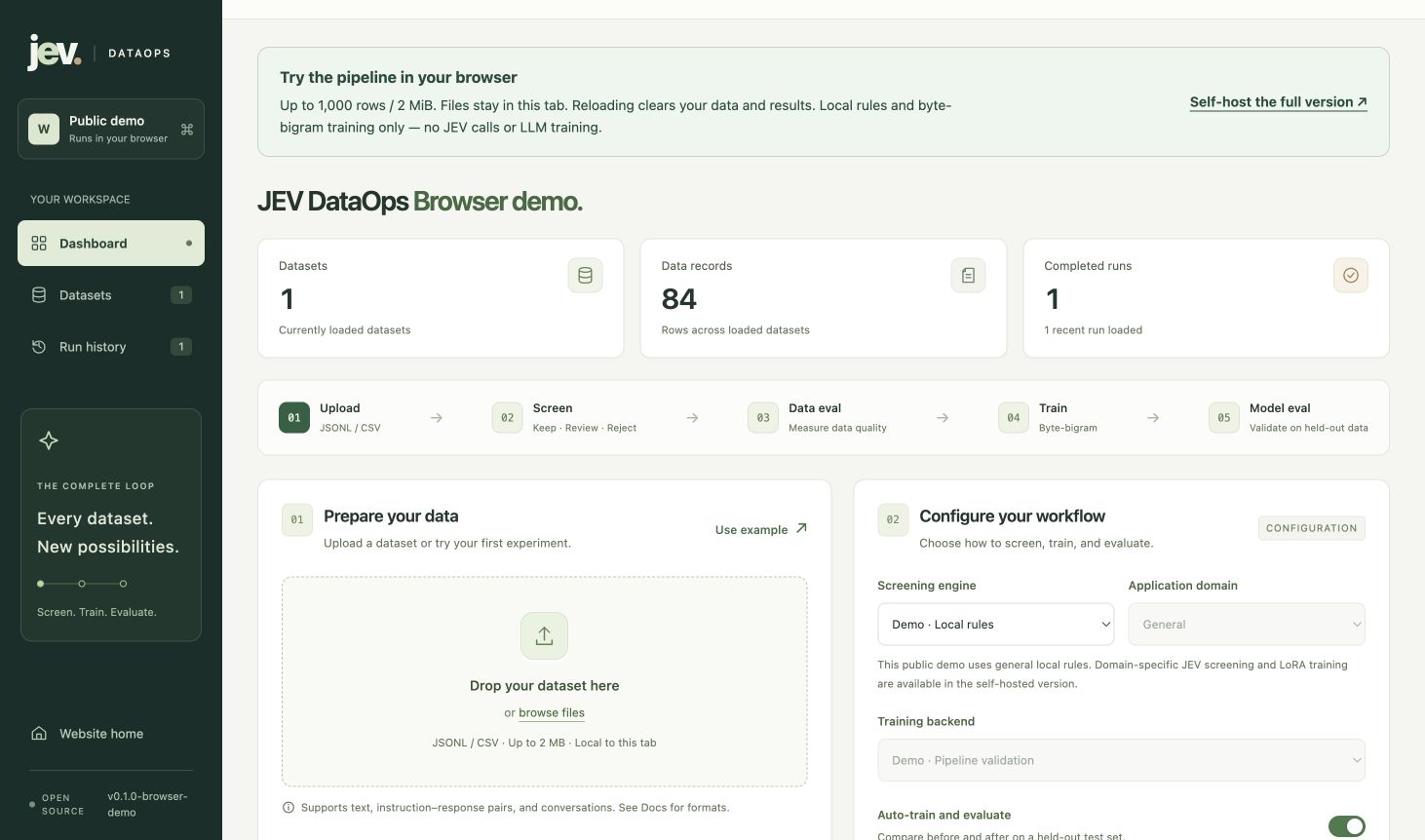
Upload your data, use JEV to decide what to keep, fine-tune your model, and compare the results—all in one workbench. Every run saves the screening decisions, dataset splits, and evaluation reports so you can see what happened.

Source: community catalog. Details and metrics reflect the published community snapshot and are not a performance endorsement. Documentation details extracted from GitHub · the README · the project website.

Keep exploring

Similar to jev-dataops

Browse all
jev-bot project preview
Benchmarks & research
Self-hosted Jev decision workbench and Feishu bot: automatic choices, probabilities, and experimental word/character writing.
JevForge project preview
Benchmarks & research
End-to-end Jev-style structured-decision stack for auditable data construction, Qwen3.5-0.8B training, fixed Mind2Web and OOD evaluation, preliminary RLCD, local serving, and interactive replay.
reflexbench project preview
Benchmarks & research
ReflexBench — open benchmark and evaluation harness for System One models and typed decision engines
Jev for robotics
EmbodiedJev: MuJoCo robot decision workbench with MiniCPM5-2B, Jev and compatible model APIs
hermes-jev-skills project preview
Browser & computer use
Jev-powered model routing, memory, compaction, skill selection, computer and browser use for Hermes agents (also Claude Code and Codex)
jev-cli project preview
Applications
CLI for TypeSafe AI's Jev evaluation model — typed questions in, structured JSON answers out
OpenDecision project preview
Applications
OpenDecision is an open-source semantic decision engine like typesafe's jev.
AnyJev project preview
Jev alternatives & open source
Turn any LLM into a Jev-style decision model: typed decisions, real probabilities, no training. (continue updating)
langchain-loadout project preview
Integrations
Per-turn skill selection for LangChain and deepagents agents: a fast judge picks the few skills a turn needs, so a catalog of hundreds stays out of the prompt.